
What is small business SEO? Search Engine Optimization (SEO) is a process to improve how your website ranks in search engines. The ultimate goal to drive a bottom-line result (Booth, 2020). SEO for small businesses can be contracted out as a whole to marketing companies. Clutch.co can have a list of top SEO companies for your city or country.
Alternately, as a small business owner, you can manage the process and either contract the individual tasks or do them yourself. Regardless, this blog will provide you with the tools to understand what to look for, track, and measure. Using David Booth’s LinkedIn Learnings course SEO Foundations as the base, I will provide a basic process to build off. My goal is to ensure that you, your website designer, social media team, or employees are focused on search engine optimization.
Overview of SEO: Search engines rank websites based on two significant factors, relevance and authority. The goal of SEO is to increase both relevance and authority.

Relevance:
How well the content meets the needs of your online audience? The main thing that search engines look for is keywords from the search within the webpage. Keywords are the foundation of SEO. I explain a process to know what keywords to use on this page. You can then add relevant content that supports the keyword. This becomes clearer as you understand what keywords are.
Search engines also look at your website’s interaction data to evaluate how searchers value your page. This could include time on page or website.
How well is the content implemented in your code? Is your content written with no grammar or spelling errors? Search engines are sophisticated enough to understand written language, and errors are viewed as untrustworthy. This is also true for the audience that is reading your content. My blog “bidding and tendering copywriting” provides writing advice to write clearly with editing advice.
Is it easy to navigate your website, or is it difficult to find things or to understand? A site with dead ends or no organization will not help search engines know what is on your website. Keep your site organized with a focus of one keyword per page and ensure that you have good navigation on every page. This will increase search engine confidence in your website.
How are other websites linking to your website? When other sites link to yours, it is a vote of confidence. But, the words used on the other sites to create the link are also critical information that search engines use to understand your content. For example, if the link says How to use marketing to improve your bidding and to tender, the search engine considers this. It will then use this to assume the page will contain information that will help improve bidding and tendering with marketing. On the other hand, if other sites only use hyperlinks that say here or click, they do not provide any extra info.

Authority:
Is the content trusted? When other websites link to your site, it is good if the site is trusted. Search engines give more credit to links from relevant links. Links are also how your website and new pages are found by search engines. Link-building is critical to building your website’s authority.
What sites are linking to you? The type of site linking to you. Are they spam sites? Do they provide fake interactions with your site? Building an authoritative website takes time and effort. Search engines actively look for sites that are “cheating” using Spam or Malware to deceive users or game the search algorithms. Google webmaster guidelines describe the rules for Google.
Reviews and social shares (votes of trust) Social Media shares and likes for your website content are also votes of confidence. Being active on social media and sharing your website content increases your authority. Remember to have social media buttons on your site but stay focused on the places your audience is active.
How old is the content? Old content or a stale website with no new info or regular improvement will be seen as less authoritative by search engines. By keeping current and regularly updating and producing new content will help your SEO results.
Search engines are programmed to find the best results that will provide website choices that people are looking for. Getting access is free, but the effort is not. The results page, known as SERP (search engine results page), is a combination of paid listings, organic listings, images, news, videos, maps etc.
Key to Success SEO:
Small business search engine optimization requires a plan. A strategy, one part focused on your audience and one part focused on the algorithm. There are technical concerns to be aware of, and a drive to continuously improve will help your SEO efforts.

The five areas of focus for SEO: Click to jump to a section.
- Planning and Strategy: Measurement and progress
- Customer Focus: Keywords and understanding customer to provide valuable content
- Algorithm Focus: Attracting relevant links, metadata
- Adjusting: Metrics, performance review
1. Planning and Strategy (Long-term Content Planning)
A successful plan for SEO needs to measure results against a goal or objective. To be successful in SEO, you need to define what success is. The business goal is the same for all small businesses, increasing revenue. But the revenue is obscure to measure the success of efforts for SEO, so KPIs (key performance indicators) need to be used. KPI’s are measuring things that are indicators of success. For example, customers filling in a lead form indicate a ‘very interested’ customer and more ‘very interested’ customers should equal more sales. Another example is the number of people visiting your eCommerce website should equal more sales.
All marketing plans should cover the questions below.
- Who is your customer?
- What are their needs?
- Where are they?
- Where on the internet are they?
- Where are they conversing online?
- What are your customers looking for?
- What do you want them to do?
Setting a goal and objective for SEO (What are you trying to do?). These goals are what you will be ultimately measuring your SEO efforts against. These should be focused on a KPI(s). You can think of these as business outcomes.
Possible KPI measurements.
- Phone calls
- Sales
- Leads forms
- Followers on social media
- Site traffic
- Site position on SERP
- Authority value on SERP
- Leads to sales conversion
- Time on page
- Bounce Rates
- Click Rates
- Blog Comments
- Pages per visit
- Average time on site

Understand your audience and their needs with a focus on their search intent. Consider developing marketing personas to help focus your efforts. The research your audience search intent will form the base of your keyword strategy. Keyword research will also help better understand the customer. The Keyword research is here.
Involve everyone in your organization. Sales to service, accounting to administration, the greater your team understands the plan, the more successful your SEO efforts will be. Your team can also help create content and could be used in executing your content strategy. Alternately, if you need support from outside contractors, your plan can identify what areas you are specifically looking for.
Ensure you have a policy established for your online brand. Who can represent the company, and what rules should be in place to protect your brand. If you don’t have one, HootSuite.com has a how-to and templates for social media.

A plan to measure results means that you must have systems in place to find those results.
In my blog “10 Facebook Marketing Tips: Take your small business beyond basic online marketing to exceptional,” I support the use of Facebook Pixels. Google Analytics has similar web tracking as Facebook Pixel. They both need to be installed on your website. They will analyze your visitors’ interaction with your website.
Google Search Console is a separate site and will track how your site is performing on Google’s search engine. Bing has a similar site for their search engine. This measures how your webpages rank on the SERP. Including how many times your pages have been offered (impressions), how many clicks, and what keywords your site ranks for.

2. Customer Focus:
All the content writing on your websites should focus on the customer first. Follow the basic rules for creating marketing copy, like in my blog on How to use marketing to improve your Bidding and Tendering.
Follow the top three fundamentals for copywriting:
- Plan ahead.
- Add Value to the Customer.
- Call to action.
- Write and Edit for Clarity.

Keywords the foundation of SEO
Keywords are key to all marketing copy. I provide a practical process to research keywords here.
The goal is to rank for each of these keywords that you are targeting. This means that you should have one keyword per page, and it needs to be relevant and not forced on the page. Repeating “painter and designer” 20 times on your home page will not provide the SEO unless you supply both painting and designing. Remember that search engines are ranking your sites on relevance.
How do you know if they are ultimately the right keywords? Ranking for keywords takes months of time and effort. This is where paying for keywords can be very beneficial for the short term. Search.Google.com will help you know what keywords your pages have ranked for and how many times they were clicked. You can also utilize UberSelect.com for the same analysis as on your competition.
Pro-Tip: Use an Excel sheet for keyword planning and distribution. This will allow you to map what keywords you are targeting per page on your site. It will also help you plan for pages or blogs that need to be created to capture the keywords you have not ranked for. Below is a sample of the keyword Excel that Booth (2020) provides. Link to Excel sample.
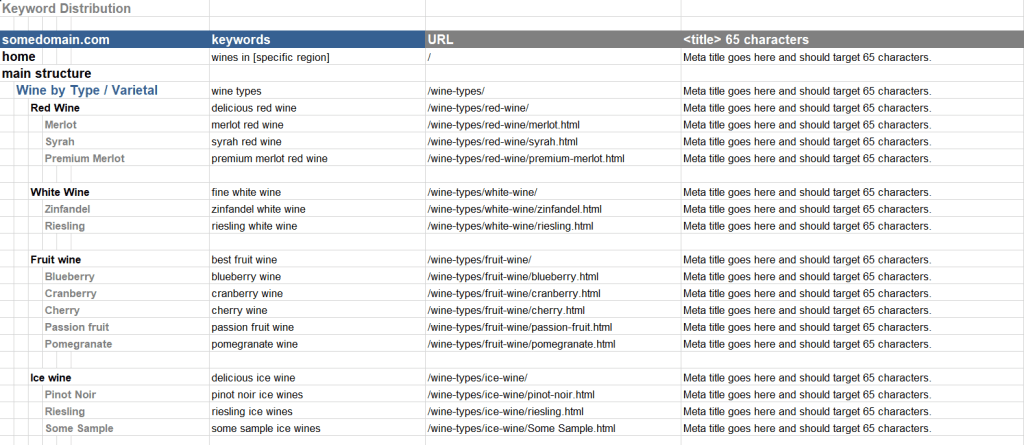
Benefits of using a Keyword distribution Spreadsheet:
- Organizes mapping of keywords to pages
- Tracks Keywords that still need pages
- Becomes a resource for team members
- Ability to adapt quickly
When trying to decide what content to add, think of broad themes. Themes like:
- Educational
- Statistical (analysis of statistical info)
- Technical (specifications)
- Procedural content (step by step how to’s)
- Informational (directions, or executive descriptions)
- New (trending and current events)
- Commenting on blogs
- FAQ’s
- Social media
- Leverage customers’ reviews, partners, vendors, peers, your professional network.

3. Algorithm Focus:
Providing information where the search engines are looking for it is focusing on the algorithm. It also means making sure that your information is clear. Photos, videos, and other non-text items are optimized with tags that the search engines can reference. The search engine needs descriptions and information for all, non-text items because it does not “see” like we do (Booth, 2020). This next section is a bit more technical, but you can still do it yourself with some tenacity.
Knowing your page’s keyword(s) is critical for this section.
URL (Uniform Resource Locator) optimization. This is the webpage address that is visible for each page. It should be as concise as possible and clear with the keyword phrase in it. Hyphening between each word to help search engine. For example; https://selectstartmgmt.wordpress.com/2021/02/03/build-a-real-estate-agent-linkedin-profile-with-example/. For my site, the point past the date is editable. It clearly describes the blog post that it references. Of particular note, ensure you are using HTTPS vs. HTTP Google has started to prioritize secure sites.
Every web page you have should have a unique URL with its keyword it focuses on.

Meta Tags are code that is not displayed on the webpage (Morris, 2019, para. 1). They include several tags but specifically title tag, meta descriptions, H1 header, and Micro tags are areas to focus on. Provide clear descriptions integrate and keywords only where they fit naturally.
Title Tag Use a short description with something to convince people to read it. Should also include the keyword from the page. Not too long or detracting from the keyword.
Meta Description Changing this will not improve search ranking and is not used for major search engines. It is used for the description for your page under your title on SERP. A good description will improve click-through-rates (Booth, 2020).
H1 header tag: The main visible headline and should be descriptive like a newspaper headline. It should include the keyword and explain what the content is.
Improving non-text Non-text can also be optimized with either clear or relevant text next to the non-text items. For example, referencing a screenshot below I clearly state that the photo below is a sample of schema. Google reads this and will connect that as part of the description. Microformats also provide search engines with referenceable text.
Microformats Microformats are critical to optimizing non-text items like photos, videos. Schema is code that is organized in a way that search engines can read. Both Google and Bing prefer Schema JSON-LD. Visit Schema.org for more details.
Below is an example from Schema.org for an image of a recipe. You can see below that in the code, there are specifics and clear lines that can be read by search engines. For example; author, description, recipe ingredient. These details will improve the webpage’s relevancy by helping the search engines to understand the non-text content. The clear JSON-LD content included in your site increases the relevance of your site and will increase your SEO.

Search engines look for authority in the websites they rank on SERP this requires incoming links, reviews, shares and likes on social media. You want to attract links from reputable sites. The old adage “it’s not what you know it’s who you know” is like the importance of incoming links (backlinks). The reputation of the link provider and the amount of links matter. A good SEO has a strategy to attract and improve backlinks. The general strategy is similar to business networking, look to add value, build relationships, and be a subject matter expert. It also doesn’t work to buy networking relationships nor is it good for backlinks.

Attracting and Improving links: Using tools like UberSelect.com or Google Analytics will provide a list of your existing backlinks. Compare this to the page’s performance. Also, analyze your competitor’s backlinks and identify ones that you could compete with. You might find a directory that is providing great backlinks. UberSuggest.com can help with competitor analysis.
Content is king: The primary driver for great backlinks is high quality and relevant content. Focusing on keywords and fulfilling the customer’s questions and needs. Similar to networking you will need to be actively looking for connections here are some suggestions to consider from Booth (2020).
Look to register to relevant and trusted web directories. If there is no vetting for content then it probably is not to be trusted. These can be local business directories like a Facebook business directory. Industry directories like the Canadian Home Builders Association member directory.
Find complementary sites that would have the same audience. Share backlinking and guest author blogs. For example, an electrician could consider guest authoring on a plumbers blog post talking about GFI in bathrooms.
For backlinks, quality is better than quantity, and more analysis will provide more opportunities.

4. Adjusting
Looking is not enough. Look to measure, analyze, and improve. I discussed above in the planning stage measuring is key to knowing your success. The final stage is to analyze your metrics and adjust. Below are some items to consider tracking:
SEO KPI’s
- Organic search traffic: Organic, Paid, Branded, Non-branded.
- Keyword ranking (trends)
- Revenue
- Transactional data: order size, returning customers, referrals
- Backlink portfolio # and quality
- Your page and domain authority and trends
Ecommerce
Technical detail: Metadata is critical for all items and services for eCommerce. the more detail the higher you will rank for SERP.
When developing content and identifying keywords be aware and look for customers’ requesting comparisons to other products. They might also be searching for coupons.
Much of the discussion about your products will be outside your website. You will want to monitor these and participate in the conversation.
Local Brick-&-Mortar
Technical detail: Ensuring you rank well for local search engine listings. This will need citations (business name, address, and phone number together) similar to backlinks.
Register for both Google business listing and Bing places for business.
Conclusion:
This is only the basics and I have only covered enough to start your own SEO or engage in an informed conversation with an SEO consultant. For a deeper dive Booth (2020) suggests the blogs and forums on Moz.com, LinkedIn Learning which I endorse too, or the book “The Art of SEO”. Starting my website I focused on content and keywords looking for early results. My first attempts at keywords were forced and the words that I sough did not rank. Practice and adjustment, I am revisiting the past posts to ensure I am maximizing my SEO. You too can optimize your site with a bit of effort and focus.
Readability: Grade 7
Keywords: SEO Strategies, Small Business SEO
References
Answer the Public. (n.d.). https://answerthepublic.com/
Booth, D. (2020). SEO foundations. LinkedIn Learning. https://www.linkedin.com/learning/seo-foundations/
Google. (n.d.). How Google search works. https://www.google.com/search/howsearchworks/
Google. (n.d.). Google trends. https://trends.google.com/
Morris, K. (2019). The ultimate guide to SEO meta tags. Moz. https://moz.com/blog/the-ultimate-guide-to-seo-meta-tags
Patel, N. (n.d.). Ubersuggest. https://app.neilpatel.com/
Schema. (2021). Image: A Schema.org property. https://schema.org/image
Photo References.
Focus Photo by Elena Taranenko on Unsplash
Magnet Photo by Dan-Cristian Pădureț on Unsplash
Programing Photo by Luca Bravo on Unsplash
Robot Photo by Phillip Glickman on Unsplash
Stamp Photo by Aleksey Boev on Unsplash
Scale Photo by Barbara Horn on Unsplash
Smiling person Photo by dusan jovic on Unsplash
Tape Measure Photo by Elisa Michelet on Unsplash
Tag Photo by Brett Jordan on Unsplash
Traffic Photo by Tom Ritson on Unsplash
Words Photo by Brett Jordan on Unsplash
 Select Start Management Inc.
One thought on “DIY SEO Strategy for Small Business”