

Keywords are terms or phrases used in online search related to your business, industry, or website.
The intention of keyword research is to discover information on the search terms people use. Then, creating content to support these searches. Utilizing analytic websites will provide insights into the keywords and the searcher’s intention. UberSelect.com and AnswerThePublic.com, and Trends.Google.com are the three I use.
Keywords can be simple words like “painter” or more detailed like “house painter.” They can also be very elaborate, like “why do painters wear white.” Each term will have different search volumes and difficulties to rank on the SERP (search engine results page).
Keyword research should be part of the normal business process and done many times per year.
The first step is to brainstorm what is the customer’s perspective on your products or services. Are they searching for finishing companies or baseboard installers? Gather these ideas and terms because you will use them for the start of your research. This will help develop a list of keywords that your website pages will focus on.
Suppose you are a painting company that does residential painting services. Using a simple example and a phrase will provide us different results. We will use “painter” and “house painter in Edmonton” to show the differences between them.
Specific measurements to look for are:
- Volume keyword search
- Organic search is the difficulty to rank on SERP without paying for the keyword.
- Similar searches
- When a keyword is searched (is it seasonal)
- Cost per Click
There are several tools for research. I focus on Uberselect.com, AnswerThePublic.com, Trends.Google.com.
UberSelect.com Searching for “painter,” we can see below that the volume is 90,500 per month, the CPC cost per click is $1.77, PD paid difficulty is 80, and SD search difficulty is 83.
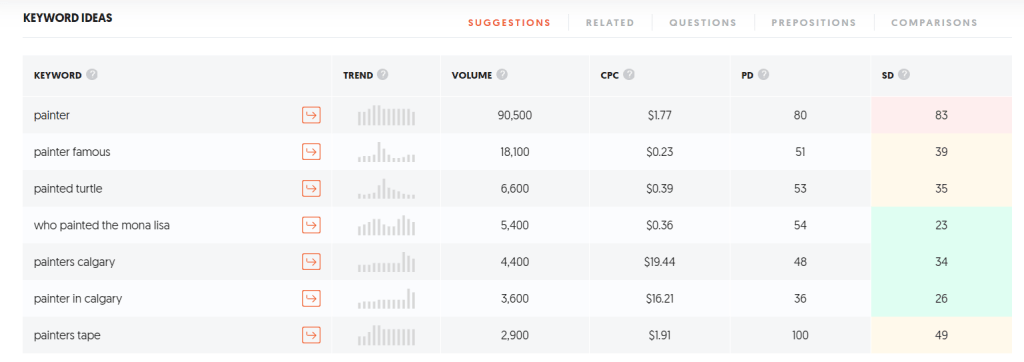
Keyword research with Uberselect
The use of a phrase is called a longtail keyword. Look below the phrase “house painter in Edmonton,” we can see that the search volume is 210 per month, cost per click of $7.65, paid difficulty is 44, and search difficulty of 27.
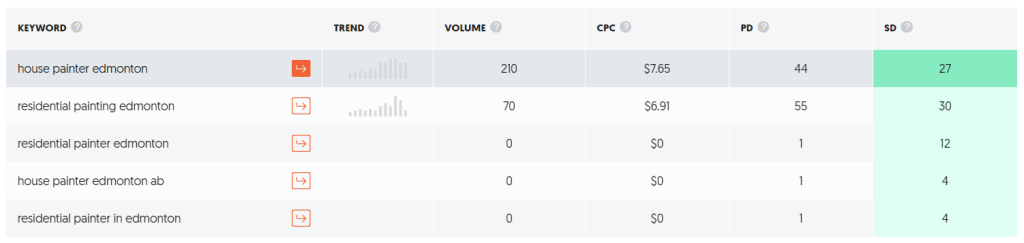
Volume: The generic term painter may provide a huge volume. It may include people that are looking up a famous artist who paints, painters products, painter how to’s etc.
A more specific phrase provides a modest search volume. Still, it is very applicable to people looking for a person to paint a house in Edmonton.
Cost per click: If you choose to pay for Keywords, this is the estimated cost per click for each term. Both results are promising but imagine the cost to a valuable lead (paying customer). If everyone clicks on your paid ad for “painter,” it would cost you $160,000 per month. Unfortunately, a large number would not be clients for your business. This is because they might not be looking for painting services in Edmonton. “House painter in Edmonton” would provide less volume but relatively more customers. If every searcher clicked your link, it would cost $1,600 per month.
Paid Difficulty: Refers to the difficulty of ranking high in search results. The lower the number, the easier it is to earn the top paid spot. “Painter” has a difficulty of 80, meaning there may be many bidders for that paid term. 44 indicates that “house painters in Edmonton” is moderately competitive.
Search Difficulty: Refers to organic search results (not paid). The lower the number, the easier it is to earn the top non-paid spot. “Painters” has a difficulty rating of 83. This means there are a large number of high-quality websites providing content for this keyword. At 27, “house painters in Edmonton” indicates some content but not of high quantity or quality. It suggests an opportunity to develop relevant and trusted content. This is the cheapest and most sustainable driver of website traffic. See my blog on SEO for more details to maximize keywords.
There is no right answer to what keywords are correct for your business. By using keyword research and adjusting your content, you can get great results. I would suggest that with a bit of effort and focus, using the “house painter in Edmonton” keyword will provide less traffic but higher sales. Your research will help you determine what the right strategy for your business is.
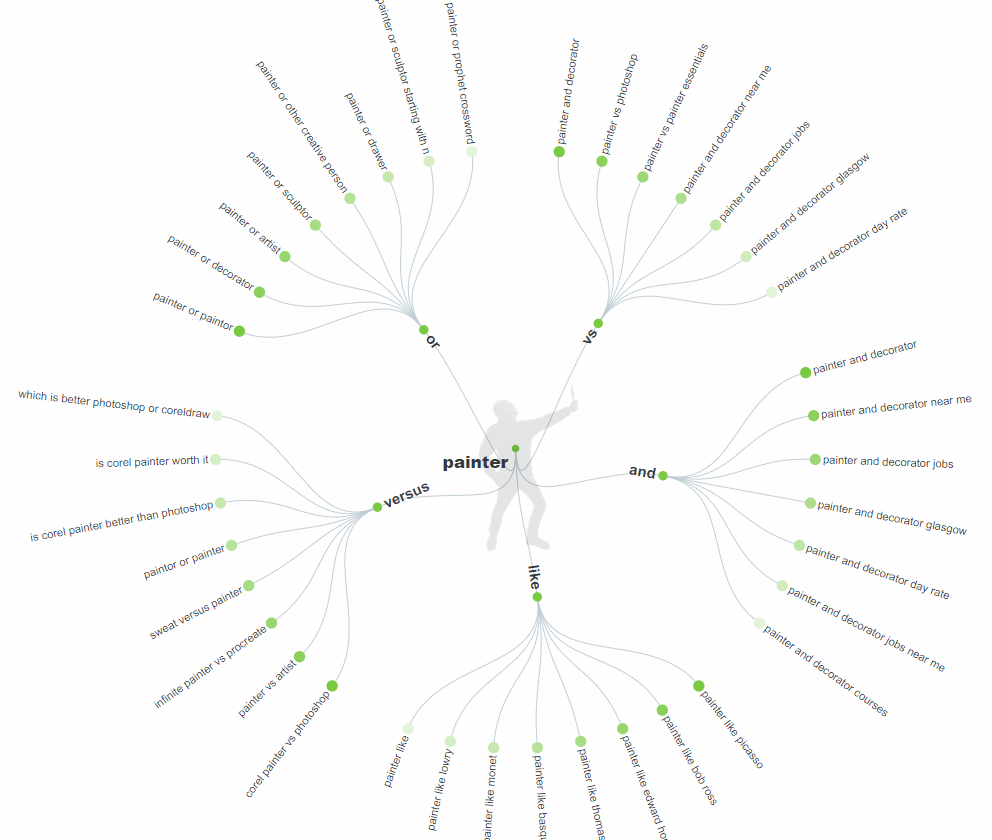
AnswerThePublic.com is a site that can help you find longtail keywords. This might help you create ideas for content or provide you with a longtail keyword that you would like to rank for.
Below, using “painter” in AnswerThePublic.com is a sample of the infographics on each search. Darker green indicates higher search volumes. You can see that “painter and decorator” was a common keyword search, along with a comparison of Corel Painter and Photoshop. This might be an excellent idea for more content on your site. (Keyword metrics, Vol 210, $5.60 CPC, 20 SD)
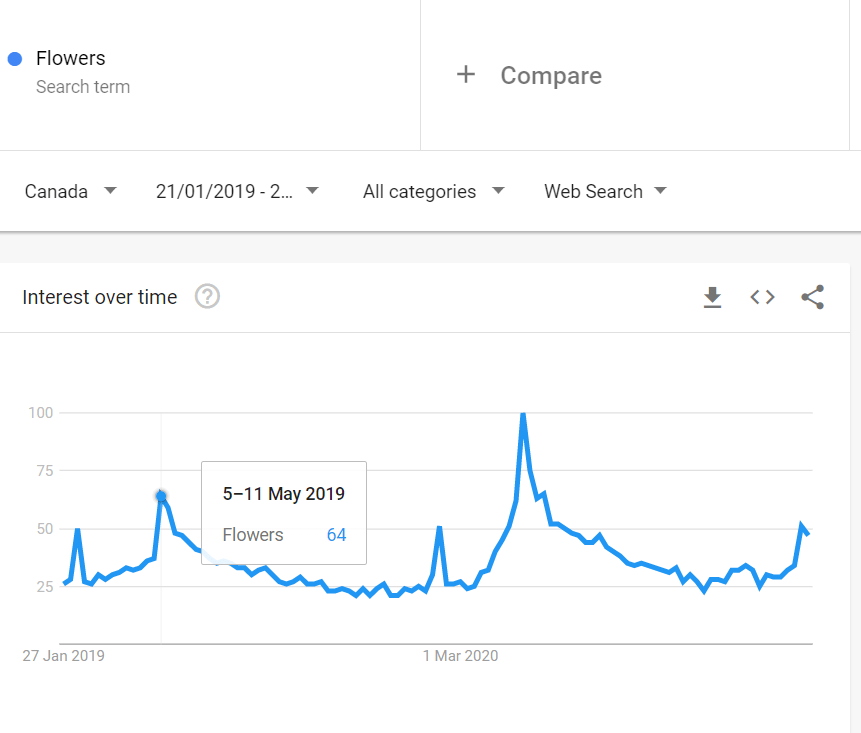
Sometimes people search keywords only at specific times of the year, “flowers” is a great example. Mother’s Day and Valentine’s Day are huge peeks in the search volume for “flowers” Keywords. To find this, we can use Trends.Google.com
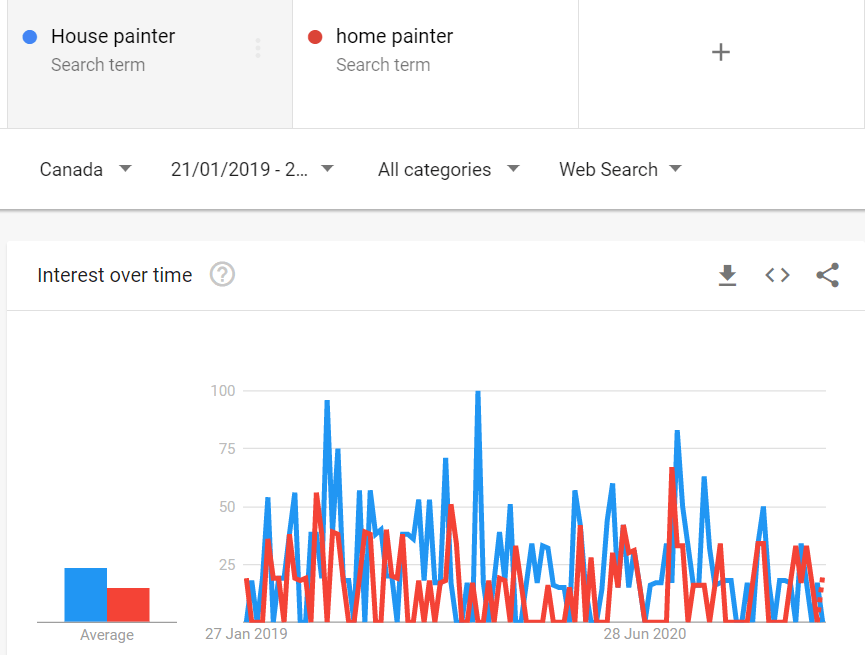
Trends.Google.com needs larger search volumes, so I adjusted the searches to “house painter” and “home painter.” While there are some cycles, it does not look like a seasonal pattern.
Below is a sample of what seasonal patterns could look like searching “flowers.” Note the spikes for Mothers Day and Valentines Day.
Keywords can (and should) be reviewed by looking at your competition’s website. UberSuggest.com offers the option to search the domain of any site (including yours). This is a great place to find keywords that you are ranking for. It also can provide keywords your competition is ranking for.
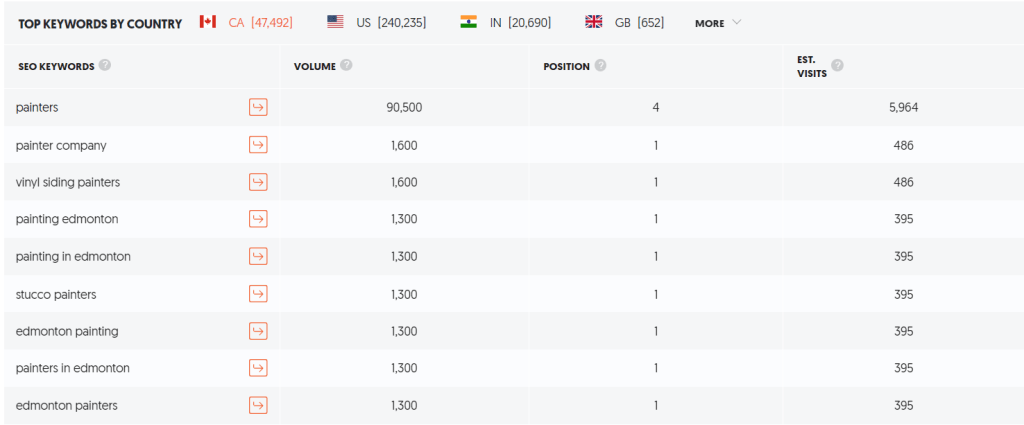
Below is a sample analysis of a company with a high SERP ranking for “house painters Edmonton.” As you can see, “painter” is one of the keywords that it ranks for. However, the second-highest phrase, “painter company,” is providing a large volume as well as “painter Edmonton.” These could be keywords to consider for your content. As a special note, even if this domain paid for the “painters” keyword, they are not getting 100% of the search volume. This is consistent across all the keywords.
What to do with the keywords you want to use.
The goal is to rank for each of these keywords that you are targeting. This means that you should have one keyword per page, and it needs to be relevant and not forced on the page. Repeating “painter and designer” 20 times on your home page will not provide the SEO unless you supply both painting and designing. Remember that search engines are ranking your sites on relevance.
How do you know if they are the right keywords? Ranking for keywords takes months of time and effort. This is where paying for keywords can be very beneficial for the short term. Search.Google.com will help you know what keywords your pages have ranked for and how many times they were clicked. You can also use UberSelect.com for the same analysis as on your competition.
Conclusion
Online marketing success is based on the quality of keywords. Developing a list of longtail keywords with low search difficulties is building my confidence. Along with search engine optimization your website is sure to be a success.
Key Photo by roberto monterola jr. on Unsplash
Booth, D. (2020). SEO foundations. LinkedIn Learning. https://www.linkedin.com/learning/seo-foundations/leveraging-the-power-of-search-to-accomplish-your-business-goals?u=2109516
Readability score: Grade 7
Keywords: Keyword research.
 Select Start Management Inc.
One thought on “What are Keywords and how to do Keyword research”