
Return on Marketing Investment is easy to calculate. Below I outline a simple and easy formula for how to calculate return on marketing investment (ROI). However the best value is to use it to measure against targets. To be successful at content marketing (or any marketing), you must measure your success. Like many CEOs and CFOs, you should focus on Return on Investment (ROI). Ok, I’ll interpret that last sentence. The big boss of many corporations (Chief Executive Officer) or their financial equivalent (Chief Financial Officer) focuses on measurements that measure benefit against the cost to get that benefit (Return on Investment).
Much like the decision to buy a new air compressor vs using hammers, the question should be, “will I make more money with this new ____(fill in the blank)____. Marketing needs to answer this same question. And, like the allure of that new pickup truck, that fills the emotional dream of a clean and cool vehicle. Marketing and its spending can also be done with pure ego reasoning. On behalf of your bank account and your accountant, don’t make business decisions with emotion only.
So how do you measure ROI for marketing?
- It starts with establishing goals.
- Select content that aligns with those goals
- Selecting your measurements to those goals.
- Estimating and Tracking for both Marketing Cost and Financial Benefit.
- Comparing results to estimates.
How to Calculate Content Marketing ROI

The base of all the measurements will be the ROI calculation.
The good news it’s not too complicated. The total sales (revenue) results in $. Use the product or service associated with the same marketing campaign.
- ROI = Net profit divided by Marketing Cost.
- So, if you sold 100 decks at $2,000 each, the sales or revenue would be $200,000.
- It cost 800 per deck in materials, and labour cost is 80,000.
- You spent $200 on Facebook advertising to get those 100 sales
- Net profit = Sales – Cost – Marketing cost
- Net profit = $200,000 – $80,000 – $200 = $119,800 net proffit
- ROI then is = $119,800 / $200 = 599% ROI
With this same formula, we can calculate the ROI and compare results. Remember to use the same marketing cost with the associated sales.
Establishing Content Marketing Goals
We all want more sales, greater returns, higher revenue. This is the basis of all ROI’s. Marketing ROI is not an exception. I am sure you have heard your marketing teams or consultants say they will provide (number) traffic but cannot say the number of sales. They have missed the point. The practice of measuring ROI starts with estimates.
Understanding Baseline
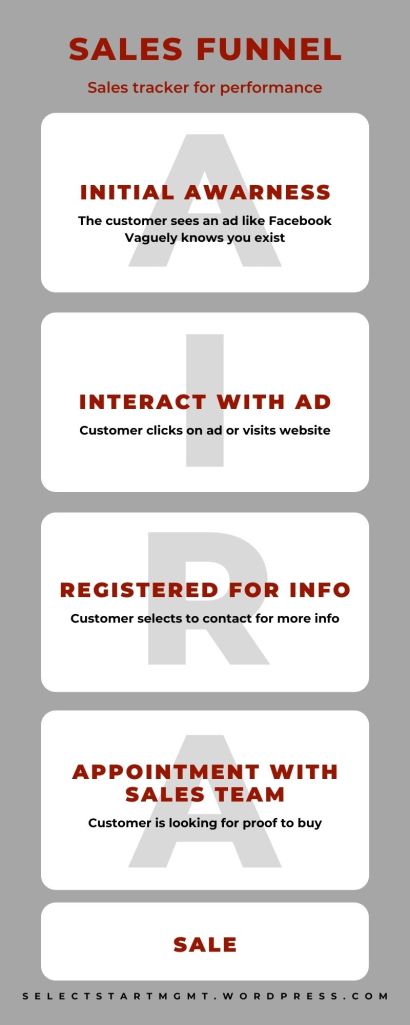
Estimating ROI requires data to measure success. Your marketing and sales funnels will play a significant role. Individual purchaser tracking is valuable, but for this example, aggregated data is better. The conversion rates are essential for forecasting or measuring performance. Each stage should have a volume of customers or reach.
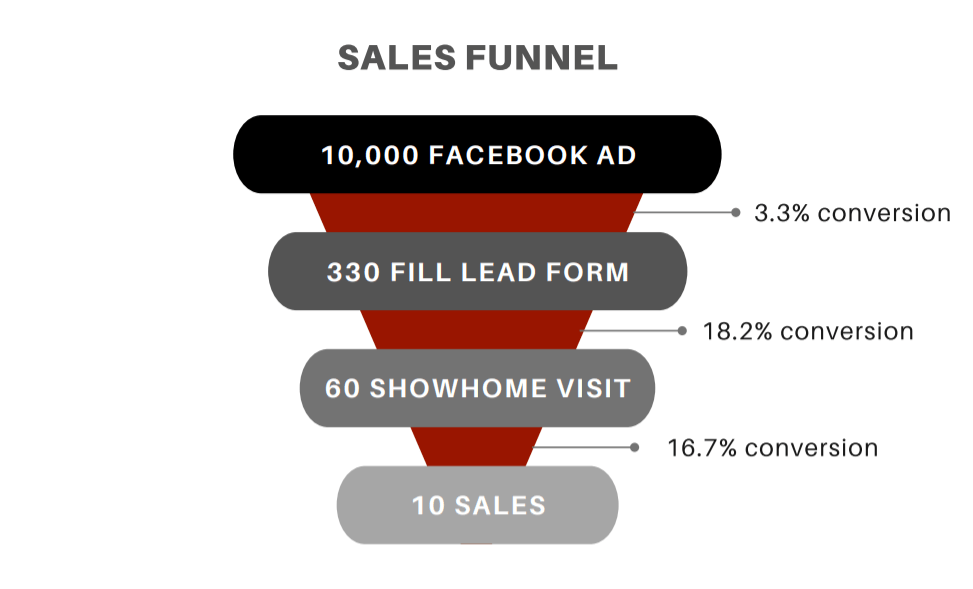
Using these past results, an estimate can be created for ALL marketing efforts. If the campaign drives 10,000 customers to your Facebook page, you can estimate to expect 10 sales. If the campaign is estimating 30 showhome visits, 4 sales can be estimated.
- Therefore for an estimate for ROI to the Facebook example, follow the is logic.
- If the cost to advertise and capture 10,000 customers on Facebook ($0.99 per click) would be $9,900.
- For each home sale, you average $50,000 (net margin) = $500,000 total
- ROI estimate = ($500,000 – $9,900) / $9,900 = 49.5% ROI
This example is simple. But estimates will will form the baseline to your goals. Wilson (2020), in her LinkedIn Learning course “Content Marketing: ROI,” provided these suggestions with the respective measurements:
- Brand awareness – Search volume, impressions, website traffic, # of video views, press mentions
- Engagement – Likes, comments, follows, shares, click-through
- Lead generation – Download, contact forms, email subscriptions, inbound phone calls
- Sales – Online, offline
- Retention and Loyalty – Renewals, attrition, net promoter score, customer referrals
- Upsell or cross-selling – % of sales or $ from existing customers, # of options purchased.
What if you have not measured these yet? Don’t worry. Use industry-standard or Content Marketing Institute (CMI) research to base your estimates on. Start measuring and tracking your results.
To be successful at tracking these metrics, you will need understanding and buy-in from throughout the company. For example, your Sales team and Sales Manager need to report accurate numbers to measure. The accounting department needs to track the revenue and marketing costs associated with the campaign.
Pro-Tip: If you do not trust your sales teams’ reported traffic numbers, train them to understand the implications. The data will provide more value to them. If traffic is meagre, it will allow you to adjust and try another campaign. However, if the traffic is working and the numbers are reported low, then the campaign might be viewed as not working, and so you should stop. If the numbers are reported correctly, then you could improve that campaign to drive even more customers.
Many Sales professionals are measured by their conversion rates and are, therefore, “motivated” to report low traffic as they close more deals per person. Review what you measure for a person’s (not business) performance. These measurements WILL affect how people report and do their jobs. Sales unfairly are in control of both the reported input numbers and output numbers of their performance metrics.
Define goals

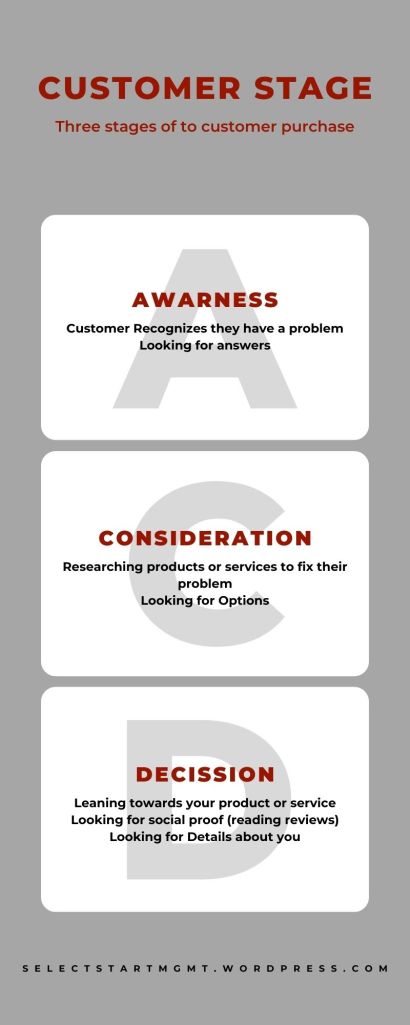
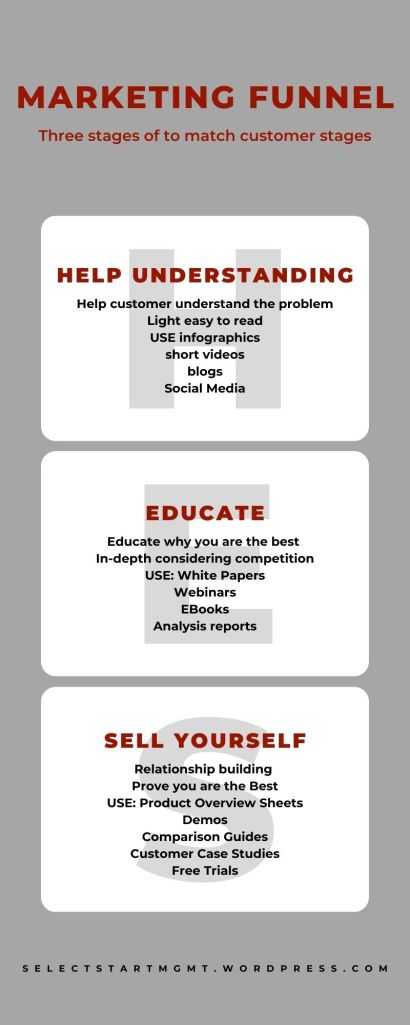
Defining the goals is easier said than done. To start, you can focus on how the content can solve a company goal or how it can fill gaps or provide opportunities (Wilson, 2020). Use the above infographic for generating ideas of the customer stage, marketing funnel stage, or sales funnel stage that would provide your business with the greatest benefit.
Creating Content to Drive Results
To be successful with content marketing, you should refer to my SEO optimization page to determine the content you should create. You will also need a target audience like in my blog for building customer personas.
Consider what content will align with your goal.
Reporting Campaign Performance
Completing the full cycle of ROI, you need to measure your performance. Ending sales and revenue are one, but through the process, several steps should be measured.
Wilson (2020) provides these suggested tools:
Tools for analysis and tracking
- Social media: Buffer, Sprout Social, I use Hootsuite
- Online: SEMrush.com, Moz.com
- Email: Open rates, Click-through, Unsubscribe, Conversions. To get help with email metrics.
- Website: Google Analytics, Crazy Egg
Conclusion

Content marketing is an ever-evolving process that you need to adjust as you go (Wilson, 2020). Stay up to date marketing research and trends. Measuring your results is key to changing the results. Ensure you have a good tracking process. As a General Manager, clear and current data helped provide me with the information to adjust our strategy to meet the company goals. You should also rely on the data. There are tools and resources available that can make this achievable event for a startup.
Readability: Grade 7
Keywords: Return on Marketing Investment.
References
Content Marketing Institute. (n.d.) https://contentmarketinginstitute.com/what-is-content-marketing/
Wilson, V. (2020). Content marketing: ROI. LinkedIn Learning. https://www.linkedin.com/learning/content-marketing-roi/why-calculate-roi-of-content-marketing?u=2109516
Booth, D. (2020). SEO foundations. LinkedIn Learning. https://www.linkedin.com/learning/seo-foundations/leveraging-the-power-of-search-to-accomplish-your-business-goals?u=2109516
[Green Math] Photo by John Moeses Bauan on Unsplash
[Chart] Photo by Markus Winkler on Unsplash
[Typewriter] Photo by Markus Winkler on Unsplash
[Cart Racing] Photo by Alexander Andrews on Unsplash
 Select Start Management Inc.
One thought on “Return on Marketing Investment for Small Business: Easy to Understand Formula”